Heat Transfer
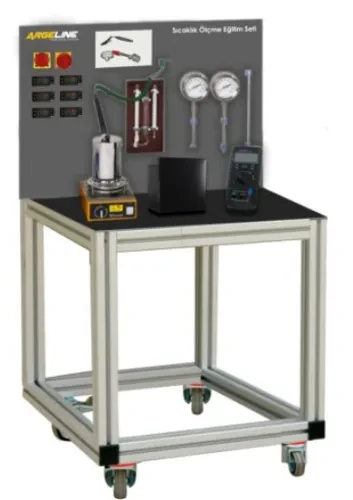
TEMPERATURE MEASUREMENT TRAINING SET

The temperature measurement training set includes electric temperature sensors, which are the most commonly used in automation applications, while traditional types of thermometers are still widely used in many fields. This training set experimental setup covers all temperature measurement methods. It includes non-electrical measurement methods such as gas and liquid-filled thermometers and bimetallic thermometers, as well as all typical electrical measurement methods. Electrically measured temperatures are displayed directly on programmable digital screens. Temperature-proportional output voltage signals (0…10V) can be accessed via laboratory jacks, allowing temperature characteristics to be recorded, for example, with a plotter. A psychrometer with two thermometers is available for measuring relative humidity, where one thermometer measures the dry temperature. The wet thermometer is covered with a wet cotton cloth and measures cooling by evaporation. The temperature difference allows the determination of relative humidity. A precise resistive digital multimeter is used to calibrate the electrical measuring devices. Various heat sources or storage units (immersion heater, thermos, and laboratory heater) allow the attainment of relevant temperature ranges for the sensors being tested.

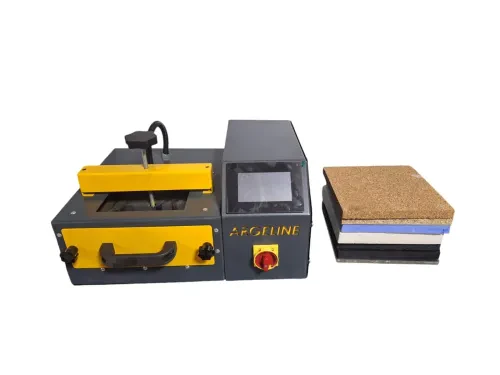
THERMAL CONDUCTIVITY EDUCATION SET FOR BUILDING MATERIALS

Our education set includes samples made from various non-metallic building materials used to investigate thermal conductivity according to DIN 52612. The samples consist of Armaflex insulation panels, chipboard, PMMA (acrylic glass), styrofoam, polystyrene (PS), polyoxymethylene (POM), cork, and plaster. All samples have the same dimensions and are placed between a heated plate and a water-cooled plate. A clamping device ensures reproducible contact pressure and thermal contact. The heated plate is warmed by an electric heating mat. The cold plate temperature is maintained by water cooling. Sensors measure temperatures at the cooling water inlet and outlet as well as at the center of both plates. Temperatures for the hot plate above the sample and the cold plate below the sample are adjusted using the supplied software. A temperature control system guarantees constant temperatures. Heat flow between the hot and cold plates passes through the sample and is measured with a special heat flow sensor. The entire enclosure, including the cover, is thermally insulated to ensure stable environmental conditions.

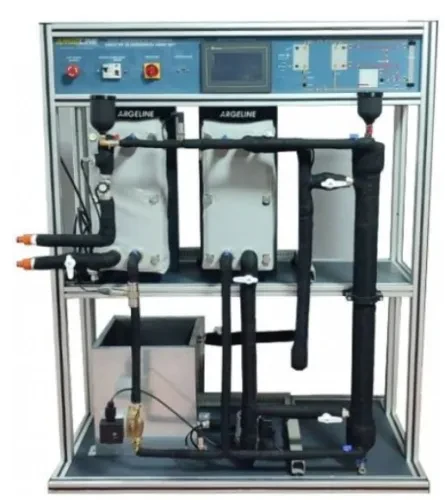
DIFFERENT TYPE HEAT EXCHANGER TRAINING SET OPERABLE WITH NANO FLUIDS

Our experimental set is designed to demonstrate the effect of hybrid nano fluids on thermal performance in heat exchangers and includes two different heat exchangers. The difference between the plate heat exchanger and the shell-and-tube heat exchanger is shown. In nano fluid liquids, the heat transfer surface is increased to accelerate heat transfer and shorten the heat transfer duration.

INVESTIGATION OF THE EFFECT OF HYBRID NANOFLUIDS ON THE THERMAL PERFORMANCE IN HEAT EXCHANGERS TRAINING SET

Our experimental set is designed as a device where you can monitor heat transfer and pressure drops using different types of nanofluids in a tube-type heat exchanger along with an FX type plate heat exchanger. These heat exchangers are compared with our experimental study by conducting flow analysis under the same inlet conditions using the Ansys software. This experimental set also offers the opportunity to examine the performance of plate heat exchangers with different fin designs, which can be evaluated in terms of product development.

CONDENSATION HEAT TRANSFER EXPERIMENT SET

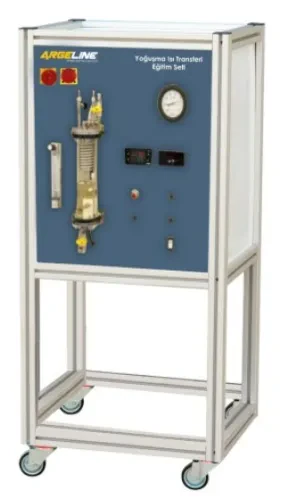
Our condensation heat exchanger training set is designed to provide visual and quantitative results related to heat transfer in shell and tube type water-cooled condensers. The training set allows the examination of single, double, or four-pass cooling water flow through condenser tubes using three interchangeable manifolds. The unit is standalone and designed for benchtop use, featuring its own steam generator and condenser tubes housed within a single thick-walled glass cylinder. Instrumentation monitoring cooling water flow rate, temperature, and pressure drop along the tubes enables comprehensive experimentation. The unit is easy to control, quickly stabilizes, and allows investigation of many different conditions within a single laboratory session.

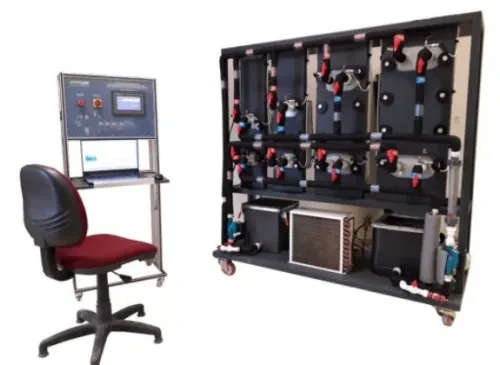
BOILING AND CONDENSATION HEAT TRANSFER EXPERIMENT SET

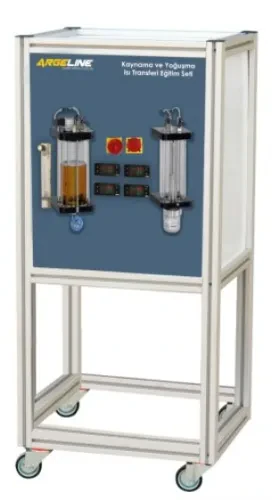
In engineering applications, boiling and condensation processes characterized by very high heat fluxes are encountered. For example, in a closed-loop power cycle, pressurized water is first converted into steam in a boiler. Then, it expands in a turbine and is condensed back to liquid form in a condenser before being pumped back to the boiler to continue the cycle. Evaporators and condensers, which are main components of vapor compression refrigeration cycles, are other typical examples where heat transfer occurs during boiling and condensation. Nowadays, boiling is utilized to improve the thermal performance of advanced electronic devices due to its high heat transfer capability. For the rational design of such systems, a good understanding of phase change processes is essential. With our educational set, the isothermal change also occurs at constant volume. Transparent tanks allow observation of the state change. Air is used as the test gas. In the first tank positioned on the left, the air volume sealed airtight is decreased or increased using a compressor and hydraulic oil. This results in an isothermal state change. The compressor can also operate as a vacuum pump. If changes occur slowly, the state change takes place at nearly constant temperature. In the second tank on the right, the temperature of the test gas is increased with a controlled electric heater, and the resulting pressure increase is measured. The volume of the enclosed gas remains constant. Temperatures, pressures, and volumes are measured electronically, displayed digitally, and transferred to a computer for processing.

BOILING HEAT TRANSFER EXPERIMENT SET

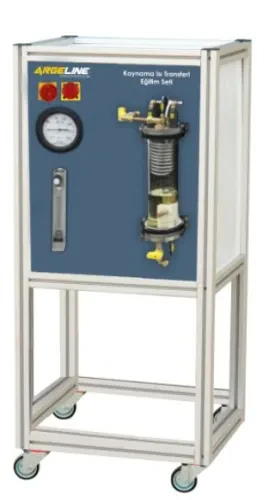
The boiling heat transfer training set is designed to allow students to experimentally examine convective, nucleate, and film boiling. The unit consists of a high-strength transparent glass cylinder with an instrumented electric heating element immersed in a volatile solvent boiling at low pressure. An integrated water-cooled condenser coil enables control over a wide range of negative and positive pressures depending on the local water supply at atmospheric pressure.

MODULAR HEAT EXCHANGER FEED UNIT EXPERIMENT SET

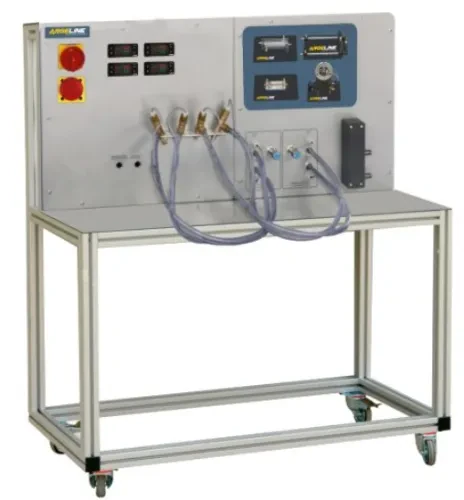
The modular heat exchanger feed unit demonstrates the efficiencies and operating principles of different heat exchangers. In this training set, the temperatures and flow rates of the water inlets and outlets are measured. Fundamentally, it is a device that enables heat transfer between two fluids. The distinctive feature of the heat exchanger is that it performs heat transfer between these two fluids, which can be in liquid or gas form, without allowing the substances to mix. Typically, plates or other heat transfer surfaces used inside heat exchangers both separate the fluids and facilitate the transfer of heat from one fluid to the other.

EXTENDED SURFACE HEAT TRANSFER EXPERIMENT SET

A small-scale benchtop training set designed to measure the temperature profile and heat transfer along a horizontal extended surface (cylindrical pin). One end of a small diameter uniform rod is heated, and the heat flowing along the rod by conduction is lost to the surroundings through a combination of natural convection and radiation. The resulting heat transfer provides a temperature profile that can be investigated and predicted with traditional analysis.